Ads

Showing posts with label Science!. Show all posts

Wednesday, June 8, 2016

How Dark is Your Personality?

According to BBC, this quiz is inspired by real psychological research... so here goes! :)

If you want to take this test, here's the link: http://adf.ly/1azfLt
(wait a few seconds after clicking the link and then click Skip Ad at the top right corner of the screen)


Machiavellianism - "the employment of cunning and duplicity in statecraft or in general conduct".

Narcissism - excessive or erotic interest in oneself and one's physical appearance.

Psychopathy - is traditionally defined as a personality disorder characterized by enduring antisocial behavior, diminished empathy and remorse, and disinhibited or bold behavior.

Source: http://adf.ly/1azfLt


So, what's your result? :) Feel free to share them in the discussion comments below and we can all be "infrequently vile" to each other :P

For more 'tests' such as this one, feel free to check out my other posts:

Tuesday, December 29, 2015

Best Science Documentaries on Daily Motion

A list of the documentaries that I've enjoyed :) Have fun watching!

1. BBC Documentary - The Creative Brain: How Insight Works


2. BBC Science - Are Video Games Really That Bad?


BBC Horizon 2015 || BBC Science | Are Video... oleh Burak_Kavakc

3. NOVA Science Now - Human Brain: How Smart Can We Get


BBC DOCUMENTARY 2015 Human Brain How Smart Can... oleh Documentarychannel1

Very interesting! Writing down/journaling about your feelings and anxieties prior to a highly stressful situation helps your brain perform better... and reduces the chance of you getting that dreaded "going blank" phenomenon, especially during exams.

I used to journal on paper during my high school years - coz well, I love to write, so why not? Hehe :P But then I switched over to typing... hence, the birth of Aveyn Toh's blog... where I write prior to stressful situations like exams or rushing assignments for deadlines... I used to think I was procrastinating lol.. but now, maybe... just maybe, my brain is trying to teach me to offload the stress via my writing, so I can perform better later on :) Amazing!

4. NOVA Science Now - How Does The Brain Work?


HOW DOES THE BRAIN WORK? - NOVA SCIENCE NOW... oleh valeriivankov


5.


Wednesday, September 23, 2015

Find out your EQ score!

Emotional Quotient (EQ) is becoming an important part of our daily lives. Knowing how you'll react with other people may give you a hint as to how high (or low) your EQ is. However, to know more specifically, what your EQ score is (much like IQ scores), you'll need to test yourself via an EQ Test.

I've checked through several EQ Tests and this test is the only one that seems legitimate. 

Here's the link: http://adf.ly/1OlxXW
(You can easily skip the advert after a few seconds and don't worry, as there are absolutely nothing to worry about - The link's safe.)

Have fun!


Now for my results: :P

Half of me is agreeing with the results while another half is not lol :P I mean I know I'd get less EQ (since I'm a very emotional and moody sort of person), but 60 is a tad bit too low for my comfort. hehe :P

Anyway, yeah, now you know, you might not want to hang around with me anymore since I do snap at people when I'm feeling "snappy", getting temporarily angry over "stupid lag" when playing some really intense matches, and break down in tears whenever I'm overstressed, frustrated or sad. I sometimes have bouts of feelings that made me want to yell out loud from some remote mountain top, but well, the lower score might because of the sleep deprivation that I'm suffering from or because I used my own brand of logic to answer most of the questions presented. heh :P

So, what's your results? Feel free to post them up in the comment section below! I'm really curious to know :)


Thursday, July 16, 2015

Whose #brainchild are you?

An amazing quiz that shows you detailed analysis of your brain with every choice you make in the quiz. That, and it also combines all your answers to show you whose #brainchild are you!

Here's my results, what's yours? :)

Check this out: http://adf.ly/1Kuiqi
(Just click skip after 5 seconds and you'll be brought the the site. Thanks!)


Have fun!


For more 'tests' such as this one, feel free to check out my other posts:

Face Memory Test - Do you have the superhuman ability to recognise faces from just a glance?

How Dark is Your Personality?
Stanford Sleepiness Scale: Are You Getting Enough Sleep?
QUIZ: Which TED Talk are you?
Find out your EQ score!
How old are your ears?
How many colours can you see?
Do you ever have trouble telling right from left?
Hooked on Music - What makes music so catchy?
Kuku Kube - Test your eyesight!
Twitch Reflex Challenge!
How Well Do You See Colour?

Monday, July 6, 2015

Why do we sleep?

A very nice summary from Russel Foster in his TED talk on sleep.


Saturday, June 13, 2015

Hearing Test: How old are your ears?

Actually, I've tested this out like when the video first came out, but well, somehow, I forgot to put it up here.

!!! - Do note that the headphones and computer that you're using to view the video may affect your results... so technically, the results you get might not be correct. - !!!

Also, you should view the video at highest resolution - 1080p (by going to the gear-shaped icon in the video menu bar and under the title "Quality", choose "1080P (HD)") and use headphones.

Okay, are your ears ready? Here it is! :)


If you can hear


8000 Hertz (Hz) - Average age (like everyone else) and not hearing impaired
12,000 Hz - Under 50 years old
15,000 Hz - Under 40 years old
16,000 Hz - Under 30 years old
17,000-18,000 Hz - Under 24 years old
19,000 Hz (the sound is affected in the video, so you wouldn't hear anything) - Under 20 years old


Now for the results...

well, I'm around 25, but my ears are between 30 to 40 years old... guess I'm listening to too much music via headphones lol...

Anyway, what's YOUR results? Feel free to post them up on your social media sites and use the hashtag #HearingTest and spread the word around!

Have fun!


For more 'tests' such as this one, feel free to check out my other posts:

Thursday, March 26, 2015

Do you ever have trouble telling right from left?

I've always had this problem, so it's not really surprising to me that it took me more than twice as long to try the right/left set than the up/down set.

What to do:

  1. When you're ready, click on 'go to the first test'
  2. You'll be given either an up/down set or a left/right set to do. Identify the directions correctly as fast as you can (if it helps, you can say the words out loud)
  3. Then, as soon as you've finished, click 'finished'
  4. You'll get the time for that set. Jot it down somewhere.
  5. Then click on 'continue experiment' to proceed to the next set
  6. Repeat steps 2 and 4.
  7. Compare the timing for both sets.

Here are my times for both sets:
Up/down - 11.417
Left/right - 27.036

Anyway, take this test to find out how well you'll do! 

Monday, March 2, 2015

How many colours can you see?

Given that THE dress went viral (and I got caught up with it coz it's science lol! It's amazing :) ), I thought you guys may appreciate this test. 

Note that your computer may affect how many colours can be seen in this test. My laptop works rather fine - there's 2-3 colours that I can hardly see the difference... except when I look at both strips in the middle, I can see a clear line (due to contrasting colours) separating them.

Look at the picture below carefully and see how many different strips of colours you can differentiate! (Click on the picture to enlarge it)

Remember - Don't peek at the analysis below before you've completed the test!

Click into the pic to see the larger version!
Credits to Derval Research for the pic.


If you can see...

  1. 20 colours - You are a dichromat (2 types of cone cells in your eye) and you are among the 25%. You prefer black, beige and blue. 
  2. 20-32 colours - You are a trichromat (3 types of cone cells in your eye) and you are among the 50%. You can appreciate a range of different colours.
  3. 33 - 39 colours - You are a tetrachromat (4 types of cone cells in your eye) and you are among the last 25%. You can appreciate a range of different colours, but may seem to be irritated by yellow [Not true for me, I don't like yellow shirts but I still wear them]

I saw 39 colours in the test, what about you? :)

Wednesday, January 21, 2015

Saturday, December 6, 2014

The Science Love Song

This is so nerdy and romantic! :D


Lyrics:

I'll be the spark, if you'll be the flame
Start a reaction that can't be contained
Balance your pH by sharing my base
I'll be your star, if you'll be my space

'Cause there is no distance that I wouldn't go
Through spacetime and wormholes my matter would flow
To the edge of the universe

I'll be your G, if you will be C
Or I can be A, if you will be T
If there's a mutation I'll fix every base
Working as your zinc finger nuclease

Just like an atom, don't rip us apart
Unless you want a big BOOM in my heart

We can take it fast or really slow
But we can't know with certainty where we'll go
If at first we don't succeed, we'll try two more times
So our failure's a statistically significant try

Like an equation, it all works out
If we balance the sides there's no need to doubt

CHORUS:
This is your science love song
A place to start our chemical bond
A research endeavour
We can write the conclusion together

Just like the movies I'd steal your heart
But then you'd die...so I won't do that

If we broke up I'd be no more
I'd give up H2O for H2SO4
Take away gravity, I'd still fall for you
Share my last electron in a covalent bond for two

'Cause you're like that angle, A-cute and you're smart
Your labcoat and goggles go straight to my heart
Except that's a lie, cause the heart doesn't feel
When it comes to love the brain seals the deal

REPEAT CHORUS

'Cause you matter to me

Saturday, November 29, 2014

Monday, November 24, 2014

How humans learn to subconsciously connect with their eyes

Humans are the only primates with a large, highly visible sclera - the white part of the eye - which makes them easier to track and read than the eyes of many other animals. Imagine trying to read the emotions of a hamster without any physical cues other than what’s going on in those black, beady pools. Those adorable little enigmas...

Have you ever wondered why humans have sclera (the white parts of your eye ball) and an iris, while animals don't have the sclera?

This article just prompted me to think about this lol and I think it's fairly interesting to warrant a share on my blog :P Enjoy! 


Tuesday, September 30, 2014

My review paper is out!

My academic paper is OUT!!! :D


Uhm, on a more professional tone... yeah, my review paper's out... I'm officially a published author now... (roflmao)

...and since I'm one of the authors, I get a free link that I am allowed to share to you all, so you guys can download it for free (until 19/11/2014) if you want to.

Link: http://authors.elsevier.com/a/1PncG3PVtpMRfR

Enjoy!

P/S: And WTF, the editor addressed me as Dr! xD 

...but I didn't like it that I (or at least the university) had to pay them just so that they can take my copyright away zzz...

Wednesday, September 10, 2014

10 Unique Smells that are Detectable by Your Nose

A very interesting article on the 10 general categories of smells that your nose can easily detect and differentiate... Enjoy! :)

1. Fragrant

The research team lumped fragrant smells in with perfumery, floral, cologne, and rosy smells. Fragrant scents are the ones that seem light and natural, what is typically described by perfume and cologne manufacturers as “grassy” or “herbal.”

2. Woody/Resinous

Your nose easily picks up deep, earthy smells that remind you of the outdoors, the researchers claim. The smells are distinct to nature, which makes them easily recognizable. The team included with woody/resinous scents of musty, moldy, heavy, burnt, and smoky.

3. Non-Citrus Fruity

Opposite the hearty musk of the outdoors are the light, fresh scents associated with strawberries, banana, and certain perfumes that draw upon these natural aromas. Unlike the sharp, bitter freshness of lemon, non-citrus fruit smells may feel more “smooth” or “silky” to the nose.

4. Sharp/Pungent

You know it the moment you smell it. These smells include sour milk, fecal matter (e.g. manure), sweat, and the natural smell of things that have turned putrid or foul. These scents make you reel the instant you detect them. Oniony and garlicky smells also fall into this category.

5. Chemical

Your nose is particularly adroit at detecting synthetic smells. Even the most realistic perfume has its limits. It’s for this reason you’re able to quickly sniff out bleach and gasoline, or paint and felt tip markers. Researchers also included alcohol and disinfectants in the category.

6. Minty/Peppermint

Described as cool, fresh, exhilarating, the minty/peppermint smell has perhaps no rivals in the scent world. It’s become synonymous with cleanliness and is ubiquitous among oral hygiene products for this very reason. The researchers also include spicy in this category.

7. Sweet

Diverging from sweetness detected in fruit, the researchers classified as "sweet" the aromas of things like chocolate, vanilla, almond, and malty scents. They’re warm, and often light. Oftentimes they’ll be sold as “creamy” or “rich.”

8. Popcorn

Popcorn as the figurehead for the group may be jarring, as its neighboring groups are so unmistakable (not to say popcorn isn’t). But popcorn was grouped with other distinct smells, such as peanut butter, burnt, nutty, heavy, and warm. It’s that earthy smell that isn’t quite grass or wood.

9. Sickening

Sickening and decaying smells are a step beyond sharp/pungent smells. It’s sewage, burnt rubber, sulfuric acid, and household gas. Sickening smells are those that cause you to dry heave when the nose detects them in heavy enough concentrations. They aren’t merely “unpleasant;” they’re usually insufferable.

10. Lemon

Who could forget the trusty scent of lemon? Used in cleaning products for decades, the scent of lemon and citrus connotes freshness — like mint — with a hint of sweetness and sharpness that makes it unique from the others. It’s light and acidic, and the nose knows it instantly.
When you’re young, your brain only discerns between pleasant or unpleasant smells. It’s through gaining experience — eating a banana, being told a perfume smells like banana — that you gain a fuller understanding of its true scent.
Like kids when they are young, they don't really care whether if you're yellow-skinned or dark-skinned or whatever-skinned, they will play with you... unless of course, you reacted like a jerk or something and they will stop playing with you or avoid you. So in order words, when you're young, things may look extremely black and white to you. It is through experience that you'll gradually make out the hues in between.

Source: http://www.medicaldaily.com/10-different-smells-are-detectable-your-nose-how-did-popcorn-make-list-257395

This article is written (not by me!) based on the journal:
http://www.plosone.org/article/info:doi/10.1371/journal.pone.0073289#s4

Thursday, August 21, 2014

The Joy of Discovery


"Because of the universe's existence, and we are driven to pursue that, to find out where we came from... the joy of discovery, that's what drives us and these questions are deep within us. It fills me with joy to make discoveries every day of things I've never seen before, to know that we can pursue these answers..." - Excerpt from the video and from Bill Nye's debate.

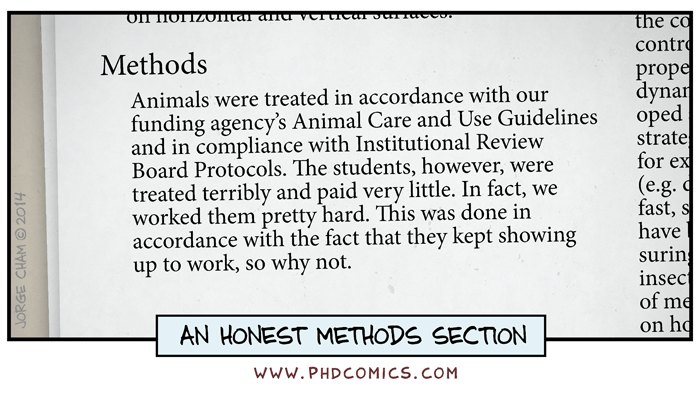
Overly Honest Methods - A Personal Compilation

Being a scientist myself... well somewhat... I'm a science postgrad in full research mode... no? Okaymeme.jpeg

Anyway, I find these so hilarious that I want to share with you guys.... and to whoever who reads my blog posts :)

Have fun laughing your heads off... I might just add a few of my own... but please don't tell my supervisor :P


----- I was forced to do that.... once. But the usual case is I created a master mix and I have some leftovers - I try to put the leftovers equally into all my sample tubes because magnetic streptavidin beads are hella expensive.
----- Yup!


--- lol, in this case, I'll be like 'Fck the experiment, my stomach is more important' and then you'll develop a guilty conscience and go 'nah, I'll just repeat this one more time... it might just take a pity on me and work if I'm hungry'
---- and in fact, lab rats (the actual rats) are treated better than the people in the labs.
----- Just the abstract of those papers ;)
----- super agree... it's more like approximately... but it's a very rough type of approximation. And since I measure the powder by directly using the Scott bottle as the 'weighing boat', it's not like I can take the powder out.
----- I used to actually read lots of papers in a day (from front to back)... then I realised that it is absolutely useless. You won't remember any of them by the time you are writing your thesis or academic paper.
----- yup, enuf said!
---- ahahaha! I'm going to aim for this achievement in my discussion for my thesis.
---- this is exactly what my BF experienced... or something like that. And in the end, dunno how many days' worth of work goes down the drain.
----- always! well, almost always!
---- yuppp!
----- I just did this for one of my graphs in my thesis and there are still 2 more graphs that needs repeating... sigh. My co-supervisor told me that this is 'normal practice' and that I should do it if I want to ever graduate... I was hooked on the graduate part.
----- protein expression and purification can be a total biatch. Seriously...
----- LOL! Like my currently under-review review paper... the reviewer wanted new information (and it's not like I didn't include 2014 papers, but he wanted more), so I just searched a list of recent papers up on PubMed using the keyword and viola! xxx new papers cited in my review... lol...
----- although this did not apply to me, but it's still pretty funny :P
----- well, the results won't turn up right and the PI will still blame you for being the 'lousy teacher'
---- like my current crappy project...
---- okay, this is a mistake that almost every fed-up beginner in postgrad does... but most of the time, it's mislabelled. You can ask my BF how he fared when he wasted months of work due to mislabelled forward and reverse primers...
----- ah... just the typical PI ego.


----- and some of these OHMs made it into academic papers as well xD
------ I'm famous for doing this in my lab lol. And I'll keep 'used' gloves around because all my data or any impromptu protocol modifications are on them :P

---- yeah, like the load of quotation work or if your PI is aiming for the professor position, his professorship application forms and documents...
----- I've failed so many times that I've lost count, so even though my negative results are 'statistically significant', I cannot explain them lol
------- yes, yes and yes! It's just 0.2 or 0.5 anyways, it'll work. xD I did that plenty of times... any pH buffer can be a pain in the ass to adjust the pH.
----- I should do this to my second reviewer who said my paper is a load of trash lol... (Unlike the first, third and fourth reviewers who recommended my paper :P) If only I knew his/her name... lol
----- like my 25 paged introduction and lit review as compared to my possibly less than 10 pages of results and discussions... oh well, time to enlarge the font size and narrow down the margins
------- try that with adding samples to a whole bunch of PCR tubes or microtiter wells and you'll cry... nah I'll just make an educated guess as to where I've stopped and proceed as usual
---- like me needing to get ethical approval for using my own urine sample in a spiking experiment...


------ lol! exactly what I did for my thesis lit review... dayum~

----- so don't test me on molecular bio jargons, I'll out-jargon you xD but I'm not taking on people who have more experience than I do in this field btw.


------- and sometimes even later because I wanted to sleep in
-------- it all boils down to the free gifts. Like the time I ordered a kit and some other unnecessary stuff (but they are reagents anyway, so I will use them.... one day) from a supplier just so I can get a chance to get free movie tickets...... I didn't get them


Source: A fake Los Angeles Times news site.


My personal experiences or other people's experiences that I've witnessed first hand 
... or maybe I've just made them up ;)

The fact that I incubated my samples in -20C overnight rather than in -80C freezer just so I could go home.

Or that I incubated my samples in the drying oven instead of the water bath or the heating cube because they were already occupied.

Or that time I was sick on a Friday and my blot was destained over the weekend... and it worked. Since then, I've destained every blot over the weekends...

Or the countless hours of 'over-incubating' my samples because I went out for a long lunch and then forgot about the time.

Or the time I copy and pasted my proposal literature review into my academic paper, my conference abstract, scholarship application AND my thesis. Recycling and reusing ftw! (Just the 2-3 pages on aptamers and the figures lol)

Or using weight balances which were not calibrated (coz some stupid idiot moved the stupid machine and didn't recalibrated it) just because there is no way in hell I'm picking up someone else's sht. I've done it plenty of times in the past but no longer!

Or the time when the waste pile is so high, that once autoclaved, a horde of drosophila spewed from the autoclave machine. Don't blame me though, it's not my turn!

Or you've forgotten to put the autoclaved Scott bottle of agar into the oven? Don't worry, put the solidified agar into the microwave oven and hope for the best!

Or my experiment involved spiking because I've tried with real samples and it didn't work.

Did you know what happens when the common lab computer has so many files on the desktop that it no longer has any space to display anymore? You probably don't, but I do. :P

Here's a quick anecdote - There was a time when I used PowerPoint to draw a gel image to provide the audience an image of the expected result of my experiment and one of the audience said to me, 'Wow, nice gel image! How did you get that?' I was like.... 'Didn't you listen to me when I was presenting? It is just the expected results...'

And some academic papers are exaggerated possibilities based on a very little not-really-accurate data. Like have you ever imagine why there are so many papers on cancer cure discoveries or 'possibilities' but none of them actually discovered the actual cure?

For more funny and overly honest methods, check these out:

If you like these sort of things, you can check out my other scientifically 'funny' stuff or personal experiences here:

The 12 types of postgraduate students in the lab

Tuesday, August 12, 2014

Who asked the first question?

The difference between apes and humans...

Apes are known to be able to learn sign languages and 'talk' or communicate like a 2.5 y/o child, but they have never been known to ask a question - they just answer. This doesn't mean that they are not curious, it's just that they are unable to comprehend that other apes may have information that they are not privy to.

In other words, they thought all organisms think and feel like they do and this sets us, humans apart from apes in the evolutionary tree (besides the obvious physical and bodily characteristics).

(It's free, you can download it and read it at your leisure)

Inspired by: 

Wednesday, July 16, 2014

Why do we have blood types?

My comments: An excellent read! Although the articles doesn't really answer the question but it provides several possibilities and well, based on those your mind is pretty much free to wonder! Enjoy! :)


Why do we have blood types?


More than a century after their discovery, we still don’t really know what blood types are for. Do they really matter? Carl Zimmer investigates.


When my parents informed me that my blood type was A+, I felt a strange sense of pride. If A+ was the top grade in school, then surely A+ was also the most excellent of blood types – a biological mark of distinction.
It didn’t take long for me to recognise just how silly that feeling was and tamp it down. But I didn’t learn much more about what it really meant to have type A+ blood. By the time I was an adult, all I really knew was that if I should end up in a hospital in need of blood, the doctors there would need to make sure they transfused me with a suitable type.

And yet there remained some nagging questions. Why do 40 per cent of Caucasians have type A blood, while only 27 per cent of Asians do? Where do different blood types come from, and what do they do? To get some answers, I went to the experts – to haematologists, geneticists, evolutionary biologists, virologists and nutrition scientists.

In 1900 the Austrian physician Karl Landsteiner first discovered blood types, winning the Nobel Prize in Physiology or Medicine for his research in 1930. Since then scientists have developed ever more powerful tools for probing the biology of blood types. They’ve found some intriguing clues about them – tracing their deep ancestry, for example, and detecting influences of blood types on our health. And yet I found that in many ways blood types remain strangely mysterious. Scientists have yet to come up with a good explanation for their very existence.

“Isn’t it amazing?” says Ajit Varki, a biologist at the University of California, San Diego. “Almost a hundred years after the Nobel Prize was awarded for this discovery, we still don’t know exactly what they’re for.”;
My knowledge that I’m type A comes to me thanks to one of the greatest discoveries in the history of medicine. Because doctors are aware of blood types, they can save lives by transfusing blood into patients. But for most of history, the notion of putting blood from one person into another was a feverish dream.
Renaissance doctors mused about what would happen if they put blood into the veins of their patients. Some thought that it could be a treatment for all manner of ailments, even insanity. Finally, in the 1600s, a few doctors tested out the idea, with disastrous results. A French doctor injected calf’s blood into a madman, who promptly started to sweat and vomit and produce urine the colour of chimney soot. After another transfusion the man died.

Such calamities gave transfusions a bad reputation for 150 years. Even in the 19th century only a few doctors dared try out the procedure. One of them was a British physician named James Blundell. Like other physicians of his day, he watched many of his female patients die from bleeding during childbirth. After the death of one patient in 1817, he found he couldn’t resign himself to the way things were.
“I could not forbear considering, that the patient might very probably have been saved by transfusion,” he later wrote.

Blundell became convinced that the earlier disasters with blood transfusions had come about thanks to one fundamental error: transfusing “the blood of the brute”, as he put it. Doctors shouldn’t transfer blood between species, he concluded, because “the different kinds of blood differ very importantly from each other”.

Human patients should only get human blood, Blundell decided. But no one had ever tried to perform such a transfusion. Blundell set about doing so by designing a system of funnels and syringes and tubes that could channel blood from a donor to an ailing patient. After testing the apparatus out on dogs, Blundell was summoned to the bed of a man who was bleeding to death. “Transfusion alone could give him a chance of life,” he wrote.

Several donors provided Blundell with 14 ounces of blood, which he injected into the man’s arm. After the procedure the patient told Blundell that he felt better – “less fainty” – but two days later he died.
Still, the experience convinced Blundell that blood transfusion would be a huge benefit to mankind, and he continued to pour blood into desperate patients in the following years. All told, he performed ten blood transfusions. Only four patients survived.

While some other doctors experimented with blood transfusion as well, their success rates were also dismal. Various approaches were tried, including attempts in the 1870s to use milk in transfusions (which were, unsurprisingly, fruitless and dangerous).

Blundell was correct in believing that humans should only get human blood. But he didn’t know another crucial fact about blood: that humans should only get blood from certain other humans. It’s likely that Blundell’s ignorance of this simple fact led to the death of some of his patients. What makes those deaths all the more tragic is that the discovery of blood types, a few decades later, was the result of a fairly simple procedure.
The first clues as to why the transfusions of the early 19th century had failed were clumps of blood. When scientists in the late 1800s mixed blood from different people in test tubes, they noticed that sometimes the red blood cells stuck together. But because the blood generally came from sick patients, scientists dismissed the clumping as some sort of pathology not worth investigating. Nobody bothered to see if the blood of healthy people clumped, until Karl Landsteiner wondered what would happen. Immediately, he could see that mixtures of healthy blood sometimes clumped too.

Landsteiner set out to map the clumping pattern, collecting blood from members of his lab, including himself. He separated each sample into red blood cells and plasma, and then he combined plasma from one person with cells from another.

Landsteiner found that the clumping occurred only if he mixed certain people’s blood together. By working through all the combinations, he sorted his subjects into three groups. He gave them the entirely arbitrary names of A, B and C. (Later on C was renamed O, and a few years later other researchers discovered the AB group. By the middle of the 20th century the American researcher Philip Levine had discovered another way to categorise blood, based on whether it had the Rh blood factor. A plus or minus sign at the end of Landsteiner’s letters indicates whether a person has the factor or not.)

When Landsteiner mixed the blood from different people together, he discovered it followed certain rules. If he mixed the plasma from group A with red blood cells from someone else in group A, the plasma and cells remained a liquid. The same rule applied to the plasma and red blood cells from group B. But if Landsteiner mixed plasma from group A with red blood cells from B, the cells clumped (and vice versa).

The blood from people in group O was different. When Landsteiner mixed either A or B red blood cells with O plasma, the cells clumped. But he could add A or B plasma to O red blood cells without any clumping.
It’s this clumping that makes blood transfusions so potentially dangerous. If a doctor accidentally injected type B blood into my arm, my body would become loaded with tiny clots. They would disrupt my circulation and cause me to start bleeding massively, struggle for breath and potentially die. But if I received either type A or type O blood, I would be fine.

Landsteiner didn’t know what precisely distinguished one blood type from another. Later generations of scientists discovered that the red blood cells in each type are decorated with different molecules on their surface. In my type A blood, for example, the cells build these molecules in two stages, like two floors of a house. The first floor is called an H antigen. On top of the first floor the cells build a second, called the A antigen.
People with type B blood, on the other hand, build the second floor of the house in a different shape. And people with type O build a single-storey ranch house: they only build the H antigen and go no further.
Each person’s immune system becomes familiar with his or her own blood type. If people receive a transfusion of the wrong type of blood, however, their immune system responds with a furious attack, as if the blood were an invader. The exception to this rule is type O blood. It only has H antigens, which are present in the other blood types too. To a person with type A or type B, it seems familiar. That familiarity makes people with type O blood universal donors, and their blood especially valuable to blood centres.
Landsteiner reported his experiment in a short, terse paper in 1900. “It might be mentioned that the reported observations may assist in the explanation of various consequences of therapeutic blood transfusions,” he concluded with exquisite understatement. Landsteiner’s discovery opened the way to safe, large-scale blood transfusions, and even today blood banks use his basic method of clumping blood cells as a quick, reliable test for blood types.

But as Landsteiner answered an old question, he raised new ones. What, if anything, were blood types for? Why should red blood cells bother with building their molecular houses? And why do people have different houses?
Solid scientific answers to these questions have been hard to come by. And in the meantime, some unscientific explanations have gained huge popularity. “It’s just been ridiculous,” sighs Connie Westhoff, the Director of Immunohematology, Genomics, and Rare Blood at the New York Blood Center.;
In 1996 a naturopath named Peter D’Adamo published a book called Eat Right 4 Your Type. D’Adamo argued that we must eat according to our blood type, in order to harmonise with our evolutionary heritage.
Blood types, he claimed, “appear to have arrived at critical junctures of human development.” According to D’Adamo, type O blood arose in our hunter-gatherer ancestors in Africa, type A at the dawn of agriculture, and type B developed between 10,000 and 15,000 years ago in the Himalayan highlands. Type AB, he argued, is a modern blending of A and B.

From these suppositions D’Adamo then claimed that our blood type determines what food we should eat. With my agriculture-based type A blood, for example, I should be a vegetarian. People with the ancient hunter type O should have a meat-rich diet and avoid grains and dairy. According to the book, foods that aren’t suited to our blood type contain antigens that can cause all sorts of illness. D’Adamo recommended his diet as a way to reduce infections, lose weight, fight cancer and diabetes, and slow the ageing process.
D’Adamo’s book has sold 7 million copies and has been translated into 60 languages. It’s been followed by a string of other blood type diet books; D’Adamo also sells a line of blood-type-tailored diet supplements on his website. As a result, doctors often get asked by their patients if blood type diets actually work.
The best way to answer that question is to run an experiment. In Eat Right 4 Your Type D’Adamo wrote that he was in the eighth year of a decade-long trial of blood type diets on women with cancer. Eighteen years later, however, the data from this trial have not yet been published.

Recently, researchers at the Red Cross in Belgium decided to see if there was any other evidence in the diet’s favour. They hunted through the scientific literature for experiments that measured the benefits of diets based on blood types. Although they examined over 1,000 studies, their efforts were futile. “There is no direct evidence supporting the health effects of the ABO blood type diet,” says Emmy De Buck of the Belgian Red Cross-Flanders.

After De Buck and her colleagues published their review in the American Journal of Clinical Nutrition, D’Adamo responded on his blog. In spite of the lack of published evidence supporting his Blood Type Diet, he claimed that the science behind it is right. “There is good science behind the blood type diets, just like there was good science behind Einstein’s mathmatical [sic] calculations that led to the Theory of Relativity,” he wrote.

Comparisons to Einstein notwithstanding, the scientists who actually do research on blood types categorically reject such a claim. “The promotion of these diets is wrong,” a group of researchers flatly declared in Transfusion Medicine Reviews.

Nevertheless, some people who follow the Blood Type Diet see positive results. According to Ahmed El-Sohemy, a nutritional scientist at the University of Toronto, that’s no reason to think that blood types have anything to do with the diet’s success.

El-Sohemy is an expert in the emerging field of nutrigenomics. He and his colleagues have brought together 1,500 volunteers to study, tracking the foods they eat and their health. They are analysing the DNA of their subjects to see how their genes may influence how food affects them. Two people may respond very differently to the same diet based on their genes.

“Almost every time I give talks about this, someone at the end asks me, ‘Oh, is this like the Blood Type Diet?’” says El-Sohemy. As a scientist, he found Eat Right 4 Your Type lacking. “None of the stuff in the book is backed by science,” he says. But El-Sohemy realised that since he knew the blood types of his 1,500 volunteers, he could see if the Blood Type Diet actually did people any good.

El-Sohemy and his colleagues divided up their subjects by their diets. Some ate the meat-based diets D’Adamo recommended for type O, some ate a mostly vegetarian diet as recommended for type A, and so on. The scientists gave each person in the study a score for how well they adhered to each blood type diet.
The researchers did find, in fact, that some of the diets could do people some good. People who stuck to the type A diet, for example, had lower body mass index scores, smaller waists and lower blood pressure. People on the type O diet had lower triglycerides. The type B diet – rich in dairy products – provided no benefits.

“The catch,” says El-Sohemy, “is that it has nothing to do with people’s blood type.” In other words, if you have type O blood, you can still benefit from a so-called type A diet just as much as someone with type A blood – probably because the benefits of a mostly vegetarian diet can be enjoyed by anyone. Anyone on a type O diet cuts out lots of carbohydrates, with the attending benefits of this being available to virtually everyone. Likewise, a diet rich in dairy products isn’t healthy for anyone – no matter their blood type.
One of the appeals of the Blood Type Diet is its story of the origins of how we got our different blood types. But that story bears little resemblance to the evidence that scientists have gathered about their evolution.
After Landsteiner’s discovery of human blood types in 1900, other scientists wondered if the blood of other animals came in different types too. It turned out that some primate species had blood that mixed nicely with certain human blood types. But for a long time it was hard to know what to make of the findings. The fact that a monkey’s blood doesn’t clump with my type A blood doesn’t necessarily mean that the monkey inherited the same type A gene that I carry from a common ancestor we share. Type A blood might have evolved more than once.

The uncertainty slowly began to dissolve, starting in the 1990s with scientists deciphering the molecular biology of blood types. They found that a single gene, called ABO, is responsible for building the second floor of the blood type house. The A version of the gene differs by a few key mutations from B. People with type O blood have mutations in the ABO gene that prevent them from making the enzyme that builds either the A or B antigen.

Scientists could then begin comparing the ABO gene from humans to other species. Laure Ségurel and her colleagues at the National Center for Scientific Research in Paris have led the most ambitious survey of ABO genes in primates to date. And they’ve found that our blood types are profoundly old. Gibbons and humans both have variants for both A and B blood types, and those variants come from a common ancestor that lived 20 million years ago.

Our blood types might be even older, but it’s hard to know how old. Scientists have yet to analyse the genes of all primates, so they can’t see how widespread our own versions are among other species. But the evidence that scientists have gathered so far already reveals a turbulent history to blood types. In some lineages mutations have shut down one blood type or another. Chimpanzees, our closest living relatives, have only type A and type O blood. Gorillas, on the other hand, have only B. In some cases mutations have altered the ABO gene, turning type A blood into type B. And even in humans, scientists are finding, mutations have repeatedly arisen that prevent the ABO protein from building a second storey on the blood type house. These mutations have turned blood types from A or B to O. “There are hundreds of ways of being type O,” says Westhoff.

Being type A is not a legacy of my proto-farmer ancestors, in other words. It’s a legacy of my monkey-like ancestors. Surely, if my blood type has endured for millions of years, it must be providing me with some obvious biological benefit. Otherwise, why do my blood cells bother building such complicated molecular structures?
Yet scientists have struggled to identify what benefit the ABO gene provides. “There is no good and definite explanation for ABO,” says Antoine Blancher of the University of Toulouse, “although many answers have been given.”
The most striking demonstration of our ignorance about the benefit of blood types came to light in Bombay in 1952. Doctors discovered that a handful of patients had no ABO blood type at all – not A, not B, not AB, not O. If A and B are two-storey buildings, and O is a one-storey ranch house, then these Bombay patients had only an empty lot.

Since its discovery this condition – called the Bombay phenotype – has turned up in other people, although it remains exceedingly rare. And as far as scientists can tell, there’s no harm that comes from it. The only known medical risk it presents comes when it’s time for a blood transfusion. Those with the Bombay phenotype can only accept blood from other people with the same condition. Even blood type O, supposedly the universal blood type, can kill them.

The Bombay phenotype proves that there’s no immediate life-or-death advantage to having ABO blood types. Some scientists think that the explanation for blood types may lie in their variation. That’s because different blood types may protect us from different diseases.

Doctors first began to notice a link between blood types and different diseases in the middle of the 20th century, and the list has continued to grow. “There are still many associations being found between blood groups and infections, cancers and a range of diseases,” Pamela Greenwell of the University of Westminster tells me.

From Greenwell I learn to my displeasure that blood type A puts me at a higher risk of several types of cancer, such as some forms of pancreatic cancer and leukaemia. I’m also more prone to smallpox infections, heart disease and severe malaria. On the other hand, people with other blood types have to face increased risks of other disorders. People with type O, for example, are more likely to get ulcers and ruptured Achilles tendons.

These links between blood types and diseases have a mysterious arbitrariness about them, and scientists have only begun to work out the reasons behind some of them. For example, Kevin Kain of the University of Toronto and his colleagues have been investigating why people with type O are better protected against severe malaria than people with other blood types. His studies indicate that immune cells have an easier job of recognising infected blood cells if they’re type O rather than other blood types.

More puzzling are the links between blood types and diseases that have nothing to do with the blood. Take norovirus. This nasty pathogen is the bane of cruise ships, as it can rage through hundreds of passengers, causing violent vomiting and diarrhoea. It does so by invading cells lining the intestines, leaving blood cells untouched. Nevertheless, people’s blood type influences the risk that they will be infected by a particular strain of norovirus.

The solution to this particular mystery can be found in the fact that blood cells are not the only cells to produce blood type antigens. They are also produced by cells in blood vessel walls, the airway, skin and hair. Many people even secrete blood type antigens in their saliva. Noroviruses make us sick by grabbing onto the blood type antigens produced by cells in the gut.

Yet a norovirus can only grab firmly onto a cell if its proteins fit snugly onto the cell’s blood type antigen. So it’s possible that each strain of norovirus has proteins that are adapted to attach tightly to certain blood type antigens, but not others. That would explain why our blood type can influence which norovirus strains can make us sick.

It may also be a clue as to why a variety of blood types have endured for millions of years. Our primate ancestors were locked in a never-ending cage match with countless pathogens, including viruses, bacteria and other enemies. Some of those pathogens may have adapted to exploit different kinds of blood type antigens. The pathogens that were best suited to the most common blood type would have fared best, because they had the most hosts to infect. But, gradually, they may have destroyed that advantage by killing off their hosts. Meanwhile, primates with rarer blood types would have thrived, thanks to their protection against some of their enemies.

As I contemplate this possibility, my type A blood remains as puzzling to me as when I was a boy. But it’s a deeper state of puzzlement that brings me some pleasure. I realise that the reason for my blood type may, ultimately, have nothing to do with blood at all.


This article was originally published on Mosaic. Read the original article.